Showing posts with label Leicester. Show all posts

Wednesday, 29 June 2011

Public Art Corner #1


This quite outstanding example of public art, is taken from Leicester's "Creative Quarter", and is I'm told, part of a children's art trail.

It's actually pretty difficult to work out what it is, hidden behind it's shield of iron railings. My initial thought was that it was the candle from Disney's Beauty and the Beast (see below with his friend the clock).

After a really thorough inspection, I deduced that it's actually a representation of a weighing scales. I love how the artist has taken something really literal, and made it opaque and undecipherable. Top class public art.

Wednesday, 4 May 2011

Who wants to be the Mayor of Leicester?


This post gives me a great excuse to indulge my inner school boy and repost the story of former Mayor of Leicester, Colin Hall, whose trousers fell down whilst giving a talk to a primary school. See below:

http://www.bbc.co.uk/news/10465457

For those who don’t follow current goings on in the East Midland’s capital metropolis; on May 5th Leicester residents will be voting for their first elected mayor. Front runner is Labour’s, Sir Peter Soulsby, who recently resigned his position as MP for Leicester South to run for the job. I think this decision rather highlights how much power local government has to influence an areas development, particularly when compared to Members of Parliament. Contrary to popular belief, MP’s often have comparably, very little local input or influence. This is one of the reasons I’m broadly in favour of elected mayors, and believe it will give some much needed accountability to local politics and associated development.

From a planning perspective, the Conservative’s ‘Open Source Planning’ green paper, which forms the foundation of most Coalition Government planning policy, made a big deal about accountability for planning decisions and bemoaned that “...the vast majority of application decisions are made not by elected councillors, but by salaried officers.” I.e. by professional Town Planners and not local councillors. Stepping aside the issue of the legitimacy of decision maker, I would take issue with how accountable local councillors really are. I consider myself to be reasonably interested in politics, and obviously have a professional interest in planning. I’m vaguely aware of who my local councillor is (I’m thinking it’s an old chap in a blazer), but I have no idea who makes up my local planning committee, and these are the people who will actually make the big decisions on planning in my area.

My personal experience of dealing with Councillors on planning committees is hugely variable. Some committee members are knowledgeable, considered and balanced decision makers, a few of them are utterly clueless, whilst the vast majority of councillors will often vary between rational and irrational depending on the perceived, political ramifications. I have seen some absolutely shocking decisions made on several occasions and can therefore understand why the general public are often outraged and resentful about planning.

I do think it’s something of an irony that many of the important decisions which actually apply the planning system, are not made by planning professionals. As a consequence, people often blame the failings of the planning system when things that they don’t like happen, rather than looking at who made the decision, and why it was made (on the whole, I think there is very little understanding of the function of local government). More generally, it seems that local elections are mainly used as a way of displaying dissatisfaction with National Government, and that the performance of local councillors and controlling parties receives very little scrutiny.

My hope is that by appointing an elected Mayor, it gives everyone a point of account for what goes in an area, and leads to better local governance and yes, more accountability for planning.

Friday, 1 April 2011

Muirhead Tower


The University of Birmingham, where I’m currently studying, has a fine campus with many attractive buildings. But for me, the real star is the recently refurbished, Muirhead Tower.

Considering how many concrete towerblocks you see across the country, it’s remarkable how few of them actually get a decent refurb. When I lived in Sheffield, the trend was to clad blocks of Council flats in muted brown plastic – imagine a kind of beige bathroom look. Another particularly nasty approach is seen in the "Leicester City blue" painted St Georges Tower with it's orange, yellow and red panels (see below). Yes, I’ve picked the most flattering angle...


Muirhead Tower was designed by the architect, Sir Philip Dowson of Arup Associates and completed in 1967. It seems to have followed a similar path to many modernist structures of the time: initially lauded, it received awards from both the RIBA and the Civic trust, but as time went on it became rundown and unpopular, with various myths emerging about its stability and structural integrity. It so could easily have found itself demolished.

Whilst Googling for information about the building, I found the following quotes, which probably summed up many people’s attitudes:

“...the building is now infamous to both students and members of staff, and is regarded as a single most ugly building in the beautiful campus.”

“An Ugly concrete block the university couldn't knock down, because it's listed”

As someone so eruditely points out, the fact that it was listed in 1993, almost certainly saved it from destruction. Hence, when structural problems emerged around 2006, Associated Architects were appointed to carry out the work

Work on sensitive or historic environments, often highlights the importance of being “sympathetic”. I’ve never liked this term, as it seems to imply a simpering deference, or cosseting. Associated Architects scheme isn’t sympathetic, and is all the better for it. The substantial concrete mass of the building, is augmented by contrasting stainless steel blocks, cores and louvres (or are they brise soleil?). Similarly, the new windows really compliment the form of the building, whilst the result is strangely reminiscent of Roger’s Lloyds building. There’s been no attempt to hide the main elements of the building, be they old or new.


I daresay some purists will be horrified by the presence of Starbucks, and the rampant commercialism this implies. However, I really like it and can confirm that the Starbucks is ridiculously popular.

I particularly like howthe interiors contrast the unadorned concrete, with more modern materials and bright colours. It’s funny but I think the result is much more sophisticated than the more contemporary additions to the campus, even with their swathes of glass, lighting and high technology.


More generally, I’m pleased to see that there does seem to be a growing appreciation of 20th Century buildings. It’s just a shame that it’s probably too late for many of the eras finest examples.

Tuesday, 4 January 2011

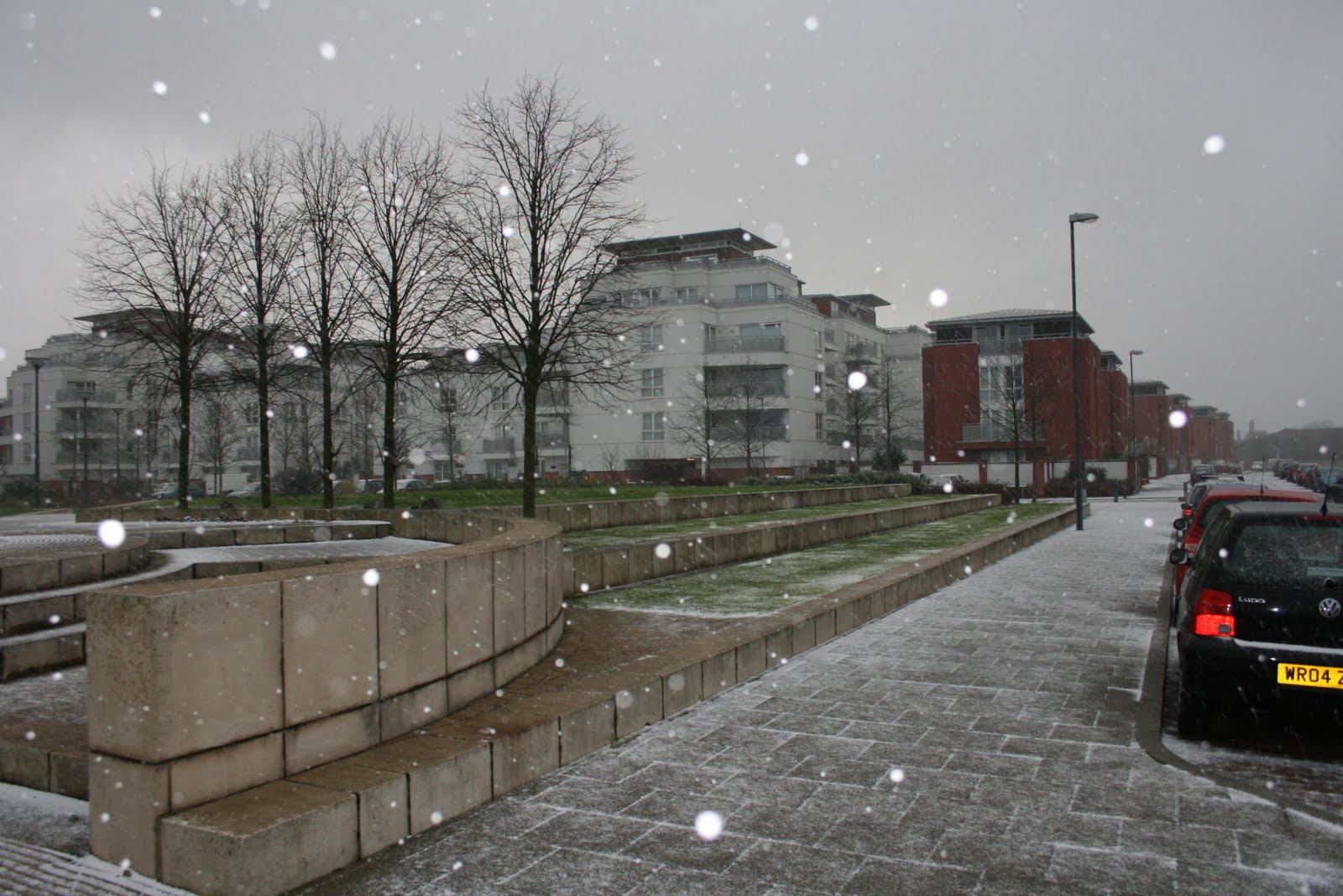
Freeman's Meadow, Leicester


I had originally intended to post these pictures at Christmas to give the blog a bit of a seasonal feel. However, the fact that we actually had snow, lying right across the UK for the whole festive period, rather kerbed my enthusiasm.


Freeman’s Meadow is one of those schemes that I’d been seeing in brochures and regeneration publications for some time, but hadn’t got round to visiting, despite being pretty close to my home. Located on a former industrial, brown-field site, close to the centre of Leicester and adjacent to the River Soar, it’s an archetypal regeneration, come “urban renaissance” project. While it’s easy to be sniffy about this kind of thing, in the context of Leicester, I do thing the regeneration of this part of the city has been welcome, in particular opening up access and development to the River Soar which has been hidden and enclosed by crumbling industrial uses. I’ve always felt that Leicester turns it’s back on the River, and am pleased to see this being reversed (albeit fairly slowly).

Hence, having finished work for Christmas 2009, I decided to drop by for a visit on my way home. And that’s when it started snowing...


In truth I was rather underwhelmed, but somewhat typically, didn’t actually get round to writing something caustic, as I had originally intended. Given that some months later the scheme was entered for the East Midlands section of the UK Landscape Awards 2010 (http://www.uklandscapeaward.org/), of which I was a judge, this probably wasn’t a bad thing. Whilst not amongst the winners, it was commended and after further consideration, I think correctly so. I later went on to judge the English entries to the awards and it was noticeable that the great majority of schemes submitted were either strategic, or rural/coastal landscape restoration schemes. Very few were urban based or involved actual implementation of designs, which I found telling.

OK, so I admit that I have rather conflicting feelings about this, but here goes:

Architecturally, I don’t think it’s going to be getting too many people that excited. However, I do think that as a form, the squat apartment blocks set amongst gardens, is a very appropriate treatment for it’s urban location in Leicester. Certainly a lot more so, than the overgrown brick boxes, arranged in cul-de-sacs, that predominate the surrounding Bede Island area. I also think that they are likely to be more appealing to people, than the city centre flats above, car parks, shopping malls and takeaways, that are currently lying unoccupied across the city (and indeed the country).


From a landscape perspective, it’s very positive that so much effort has been expended on the external spaces and this is why the scheme has been recognised with an award. The materials are high quality and frequently bespoke in nature. The design, by my former colleagues at Capita Lovejoy, is both tasteful and very well detailed. However...

... as a designer, a purist, and a pedant, I do think there are issues with the design. Whilst the bleak midwinter is probably not the best time to look at most schemes, my feeling is that the spaces probably won’t be used much. I find them rather disconnected from the surrounding buildings. This really goes to the heart of why I write this blog; my belief that landscape architecture is about more than providing a pretty setting for buildings, that it has actual and tangible function in it’s own right. Unfortunately, I’m just not sure that this scheme really is much more than an attractive setting for the buildings. :(


I think cars and how they are accommodated is a big issue for this kind of housing development. My abiding memory of visiting Freeman’s Meadow, was that there were cars everywhere. It’s something of a paradox, that if you don’t make adequate provision for cars (mainly by providing parking spaces), they end up dominating the street scene. From a design perspective, I think the ideal is underground parking (as seen at Greenwich Millennium Village), but this is often prohibitively expensive for most projects.

Conversely, I think that roads and in particular, the provision of fire and service access, are too often the overriding consideration in the design of external spaces. One of the things I like about shared spaces is that you can have access to buildings for fire and servicing, but you aren’t left with a mean, bisected space adjacent to the buildings, for pedestrians. I think this problem is well illustrated here, as residents have to negotiate a line of car parking, a road and then another line of car parking, if they want to get from their front door to the central space or the playground.


For all it’s faults, my opinions of Freeman’s Meadows and other developments of it’s ilk, are mellowing. I’m unsure what the next few years will bring in terms of urban redevelopments, but I suspect we could end up looking back with wistful affection on this sort of scheme.


Wednesday, 25 November 2009

Leicester's Bowstring Bridge Saga


I was interested to see that ongoing saga of Leicester's Bowstring Bridge, has finally made it into the national media.

http://www.bdonline.co.uk/story.asp?sectioncode=427&storycode=3153631&channel=783&c=2&encCode=0000000001a7fecf


Sadly it appears that Jonathan Glancey's article is an attempt to close the stable door after the horse has bolted, as when I drove past yesterday, the steelwork was all but gone.

I'm not really enough of an expert to tell you how significant the loss of the bridge is. I've seen similar bridges in other parts of the country, and couldn't tell you what would make a Victorian bridge particularly worthy of preservation. I guess that's why I've not commented on the issue before. However, I do recognise that the Bowstring Bridge is an important Leicester landmark, and I'm amazed that the Council are going to such trouble to get rid of it.

The more I've read about this, the more ridiculous the situation appears. As I understand, the Council is spending just under £500,000 of it's own money removing the bridge, before selling the land to De Montfort University for just £1. Apparently DMU have plans to build a new swimming pool on the site, but this is currently all we know, as they haven't released any further information about it (no drawings, no plans, zip!). However, they have repeatedly said that it is 'vital' that they have the Bridge land for the project to be feasible.

Considerable local opposition has been met by a very hard line from Leicester City Council , who's attitude seems to be 'we're knocking it down and that's that'.The wider story of this has been covered in pretty exhaustive detail by Leicester Mercury Editor, Keith Perch, on his blog. For those interested in the matter, I've put the links in below:

http://kperch.blogspot.com/2009/08/it-may-be-policy-but-is-it-legal.html


http://kperch.blogspot.com/2009/08/mercury-issues-legal-challenge-to.html

http://kperch.blogspot.com/2009/08/predictable-reaction-to-calls-for-open.html

http://kperch.blogspot.com/2009/08/council-issues-thinly-veiled-threat-in.html

http://kperch.blogspot.com/2009/08/council-letter-filed-in-drawer-marked.html

http://kperch.blogspot.com/2009/08/dismissed-with-wave-of-hand.html


Personally, I'm less interested in the aleged underhand actions of a local authority (although I'm more than happy to open this up to a wider audience), than why they have chosen to treat an important feature of Leicesters heritage, as a problem. Someone must have pointed out that the bridge was a valuable heritage feature, but the decision was made to ignore this. I suspect this sort of treatment of heritage features happens every day, up and down the country, if perhaps not quite so blatantly.

Jonathan Glancy isn't the first person to suggest alternative uses for the bridge, but those who hold the power have been adamant they're knocking it down. I would have liked to seen it developed as a linear park, similar to New York's, High Line, as I think the photo below hints at this potential.


I also think it would be wrong to finish this article without also mentioning the loss of the Pump and Tap, which is due to be demolished as part of this development. It may not be the finest Victorian building in England, but it is a good old-fashioned pub, of the sort that is fast disappearing from our cities. I suspect if it was a village pub being demolished there would be more sympathy (loss to the community etc), but people often forget that urban areas have communities that can be damaged by the loss of facilities too.

The whole thing is a sorry story, and everyone involved from Leicester City Council to De Montfort University, should be ashamed.