Showing posts with label public space. Show all posts

Thursday, 20 January 2011

Stirling and Gowan's Department of Engineering, Leicester University


Stirling and Gowan’s Engineering Building at Leicester University has been a familiar presence in much of my life. As a child, my mother studied at the University and later worked in the library, and I have vivid memories of exploring the campus, riding on lifts and searching the library basement for dusty copies of L. Frank Baum’s books. As a teenager, I studied for my A Levels at the neighbouring Wyggeston & QEI College, and overlooked the building from both my biology labs, which faced onto the “egg box” bit and the design department, which looked onto the red-brick administrative block. It was only when I went on the study architecture at university in Sheffield, that I realised that the building that I had explored in lunch hours and quietly appreciated, was of significance to anyone but myself.


On a whim, I decided to take my camera and amble over to the Leicester University campus yesterday. Strolling across Victoria Park, I took a few snaps of Denys Lasdun’s Charles Wilson Building (see above, another favourite of mine), but struggled to get a decent shot of the Engineering Department (see my rather poor effort below).
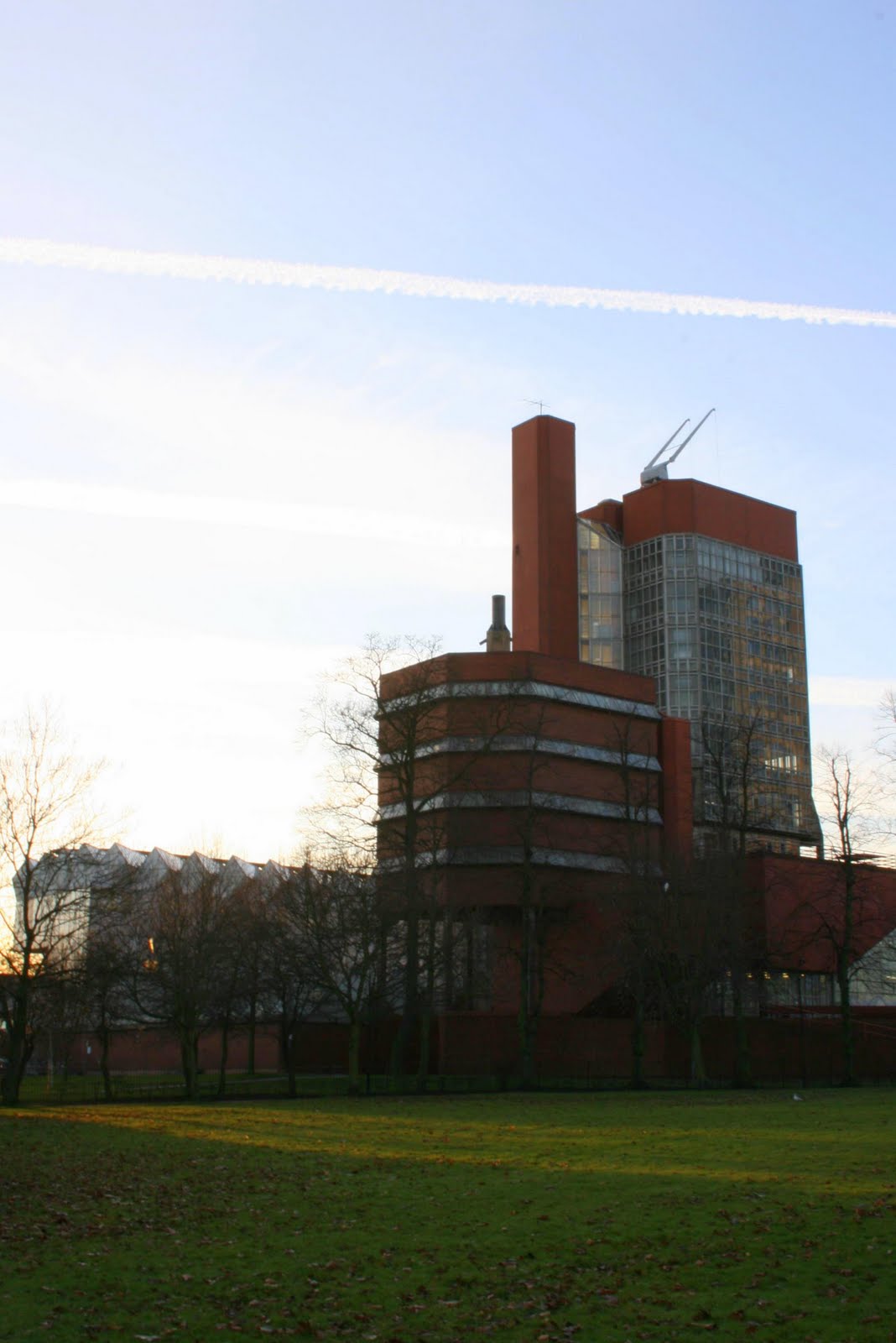


As I wander around the perimeter of the building, I’m struck initially by how dirty and poorly cared for it is. However, what quickly becomes clear is how difficult it is to get a decent view of it. Whilst partly a function of the buildings constrained site and close proximity to other buildings, you get the impression that some effort has actually been made to hide it – see the small trees that have been planted right next to it. If ever there was a building that needs to be explored and examined, it’s this one. Every view is different, and every look reveals new details and projections.


I have a theory, that our perceptions of buildings and built environment are highly influenced by the spaces and context from which we view them. When viewed from a hostile space, such as a busy road pavement, people are more likely dislike something. Conversely, buildings that can be observed in a more pleasant and contemplative environ, are far more likely to be positively received. In the case of Stirling and Gowan’s building, it is mostly viewed from a curtilage of car parks, bin stores and pre-fabricated plant sheds. I’m about to break the habit of a lifetime, but I really think that all the surrounding distractions need to be got rid of: bins, parking and in particular trees, they all need to go. It doesn’t need funky paving, granite balls or public art, it just needs some space.


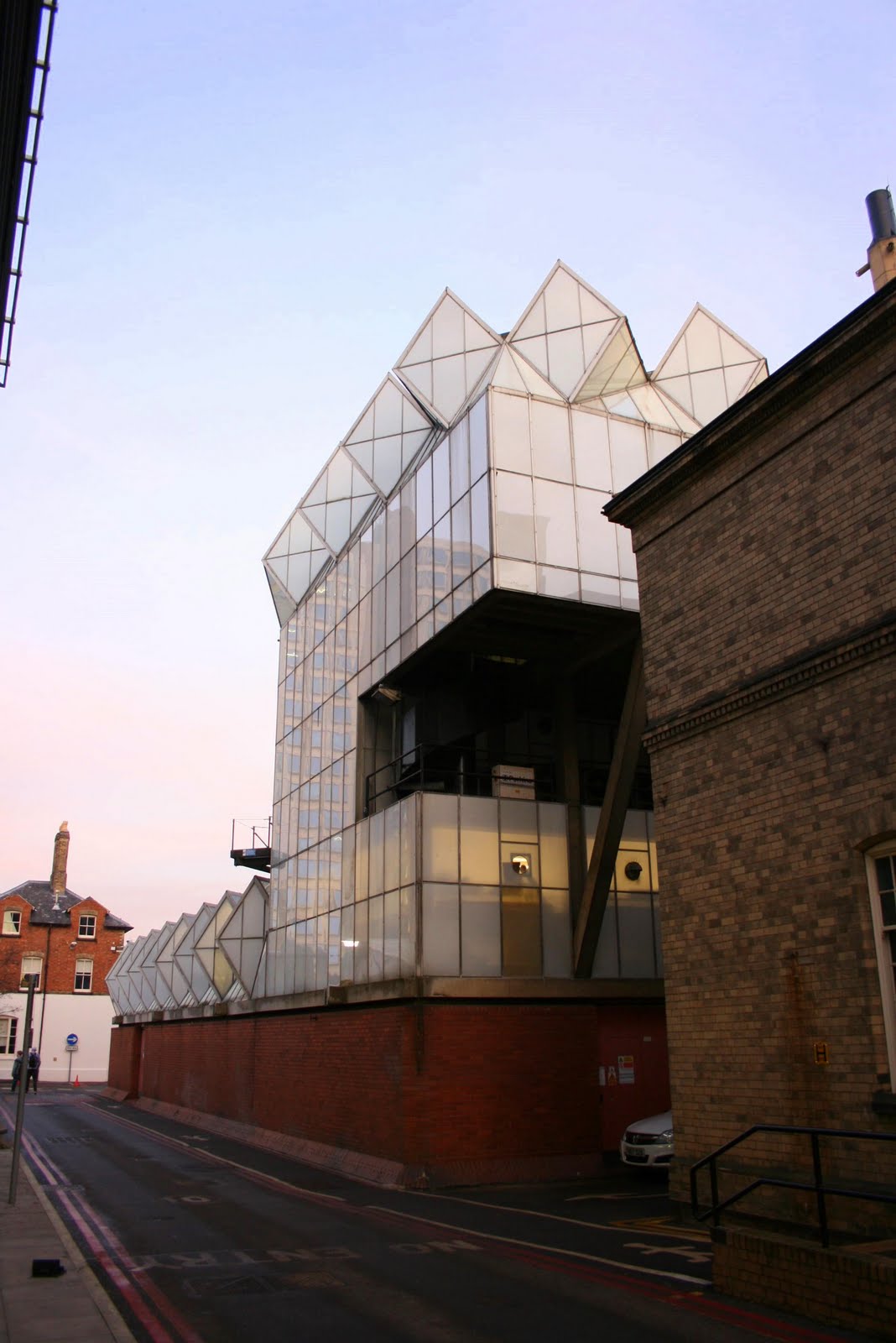


There’s something of a metaphor for Leicester in here. Whenever I talk to people from Leicester about the Engineering building, they’re usually pretty negative about it. “I don’t really like it.” “It’s badly built.” “It’s falling apart.” “It’s impractical.” “It really ought to be knocked down.” Few people seem to appreciate the interesting things about Leicester, focusing rather on facilities that other provincial cities have. I suspect that the Council would see the back of many historic buildings, a semi-thriving market and every independent shop in the city, if it would get them a Pret a Manger or a Paul Smith. See also the Bowstring Bridge fiasco.


In my opinion, the best views are from the car park by the main building entrance. I generally try to avoid architectural gushing, but as I look up at the building (careful to avoid the bemused secretary reversing her Corsa), it seems to be improbably hanging above me. The strange projections seem to trick the eye; it just doesn’t look possible that the building should be able to support itself, but there it is, seemingly balanced on an all too-small base.


Steeling myself, I venture inside. Almost immediately, my plan to appear like I’m meant to be there, falls apart as I stare in confusion at the stairs. Is that a service stair? Are they doing rebuilding work? And then I get it, and start to climb the steps, sheepishly chuckling like someone who’s tried to drink the contents of a finger bowl at a Chinese restaurant. We’re meant to see all the services, how postmodern!


While I vaguely remember looking around the interior in the past, I’m still a little bit overwhelmed. If anything, the inside is even more quirky and complex than the outside. Compared to more modern buildings the lift and stair core, feels very cramped. Every floor seems to reveal new and interesting architectural incidents, some of which are slightly uncomfortable. I can’t think of the last time I felt waves of vertigo in a contemporary building!


Rather annoyingly, I can’t get really get any decent photo’s looking out, as the glass is too dirty. So I abandon my attempts to get to the top and head back down again. I feel disappointed that I’ve not taken some better pictures of the interior. In particular, a spectacular, glass roofed landing which marks the top of the the smaller half of the tower. It was occupied by group of earnest young men with beards, and not wanting to give myself away as an interloper, I resisted taking a photo. However on further reflection, I’m actually glad that I didn’t. I think the building needs to be experienced first hand, and that if you were to see too much before, it would spoil the experience.


As I trot down the final few flight of stairs, I try to sum up how I feel about the building. Words like ‘challenging’ cross my mind and then are quickly rejected. I’ve seen others describe buildings as ‘thrilling’, but never really understood this before. Lingering on one of the lower landings, I’m minded of something Will Self once said. He complained that modern air travel was too boring (yes I remember how he livened up one plane journey), and that in order to make it more exciting we needed daring pilots in winged helmets and glass bottomed planes. It seems to me that Stirling and Gowan’s building is very much like a glass bottomed aeroplane; for some it will be thrilling and exciting (myself included), whilst for others it is a rather strange experience.


As I exit the building, I’m once more depressed by the sheer crapness of this crucial arrival space. Cluttered with cars, traffic cones and brightly coloured road lines, it all points towards a building that is little loved and criminally, unappreciated. My suspicion is that it is being purposely run down in an attempt to make a case for future redevelopment (an article ran in Building Design in 2008, hinting at a partial demolition). I sincerely hope I’m wrong. I can appreciate that it is rather out of step with more modern university buildings, which are light, airy and immediate, but with a little more imagination, it could be a major feature for the University (and the City).


I do hope that my writing of this piques a few peoples interest. For anyone interested in British architecture of the 20th Century, I can only urge you to visit. It is a building that can only really be understood by experiencing it, rather than looking at it in pictures. I also suspect, that we probably won’t see it in its original form, for much longer.

Wednesday, 21 April 2010

Architects discover Public Realm


The news that Architects Stanton Williams have won the competition to design the new King's Cross Square, was met with a resounding, "Meh!", at my house.

http://www.bdonline.co.uk/story.asp?sectioncode=426&storycode=3162081&channel=783&c=1

While I'm generally pleased to see public realm projects enjoying a higher public profile, I'm less impressed that so many of them are going to architectural practices. Just off the top of my head, some other notable examples of this would be the Dover seafront which went to Tonkin Liu, and the Maidstone Public Realm that went to Letts Wheeler - both Architects and both pretty high profile competitions.

While I'm not necessarily suggesting that Architects are incapable of designing public realm (I think most good designers can probably turn their hand to anything). It does beg the question that if Architects are designing our public spaces, then what do Landscape Architects do? Having spent 5 years at University, followed by another 2 years studying in practice how to design external spaces, I'm a little concerned by this development. I guess that if this were to become the norm, then that's the point when I pack up my clicky pencils and do something else. Masterchef perhaps?!?

A big part of my dislike of the term 'landscaping', derives from the perception that Landscape Architects are only there to specify areas of grass and shrubs. I'm still haunted by the experienced developer who told me that he didn't need a Landscape Architect, as he had some guys who could put down grass and plant hedges. Weirdly this perception seems to be on the increase, perhaps due to the spread of the term 'urban design'. Until fairly recently urban design was generally agreed to be part of the Landscape Architect's remit (the pedant in me wants to say that urban design is a process, but I think that this particular battle has been lost), but with the rise of professionals who call themselves "urban designers", urban and hard landscape work seems to be be moving away from landscape architects.

In my experience, most Architects like to have a bit of a crack at designing the externals, but very rarely do they seem to understand either the fundamentals or the technicalities of designing landscape. The typical approach is to draw up the bits of the site they want for the important stuff like buildings and roads first, before filling the remaining landscape with some fancy shapes and squiggles. After which they'll usually try and post-rationalise what the landscape will be used for. If you're really unlucky, they may just want you to detail and specify their designs...


I guess you have to look at what the Architects that are getting this work are doing, that Landscape Architects aren't. Looking at the websites of the ones I've just mentioned, what struck me (other than how few public realm projects they've actually put on the ground) was the quality of the cgi's and renders they've used to illustrate the projects. To be honest, I've not seen many Landscape Architects, producing images of this quality. I think that Architects also have a little more cache with clients, and suspect that the higher turnovers of buildings also gives them a bit of an advantage on PQQ's.

It's another example of why Landscape Architects need to work harder at marketing themselves, and illustrating what they can do.

Meh!

Thursday, 22 October 2009

The Private Realm

Will Wiles' review of 'Ground Control' by Anna Minton, and his recent blog post on the subject (see links below), got me thinking about public realm in a way that I hadn't necessarily considered before.

http://www.iconeye.com/index.php?view=article&catid=1%3Alatest-news&layout=news&id=4130%3Areview-ground-control&option=com_content&Itemid=18

http://willwiles.blogspot.com/2009/10/zone-of-ones-own.html

The abiding theme of both articles is how new areas of 'public realm' are springing up in Britain's cities under the auspices of regeneration, but are in fact privately owned and managed. Many of these have restrictions for individuals, such as a ban on leafletting, which would not be possible in public owned space. The articles make a good case for how this is eroding our basic civil liberties.

You see, up until this point, I'd been thinking that public space that was not managed by a local authority was an entirely good thing...

Designing public realm is the thing that get's me out of bed in the morning - parks, plazas, streets, squares and shared space is what really interests me. I'm also passionate about regeneration; and if you ask me the way to get regeneration happening from the bottom up, then I'd suggest you start with our public spaces. Buildings by their very nature are never as inclusive as our civic spaces. The public realm is for everyone, and improvements to it demonstrate investment in a community, and that you value the people within it.

However, there has traditionally been a lack of recognition for the importance of public space. Most people I speak to seem surprised to hear that
any design is involved in the built environment, outside of buildings or gardens and I suspect many more regard it's design in similar terms to their daily bin collection - it just happens (I could quite happily start off on another 'landscaping' rant here). However, things are improving, and it seems to me that private developers in particular, have cottoned onto the value that a well designed public space can bring to their developments.

Sadly, it seems to me that there are a lot of people working for local authorities who aren't as enlightened, which brings me onto the absolute bane of my working life - 'adoption'. Not unreasonably, if you want a local authority to maintain a space, you have to agree certain standards. However, in practice if you are proposing anything more than grass and tarmac, you are often in for a difficult ride. I expect to get some stick from local authority officers, but I have simply lost count of schemes that I have seen diminished by adoption issues (I'm not going to go into commuted sums). There are many excellent and forward thinking people working for local authorities, but it often only takes one saying 'no' to scupper a proposal. While I think certain departments have a culture of saying no, the real problem is that many officers will constrain proposals by what is current in terms of maintenance. This makes it nigh on impossible to do anything new or make significant improvements to an environment.

As something of an aside, whilst reading the original book review, I was wrestling with something of a lighting adoption issue. While I have a good relationship with the local authority in question, they have one of those new-fangled PFI lighting contracts, where you have to ask a particular supplier to design your street lighting. The quality of the actual lights is piss poor, and it is nigh-on impossible to get them to adjust the design to co-ordinate with the rest of the scheme. Interestingly, there are also moves to have street lighting turn off at a certain time, as research has apparently shown that it can reduce anti-social behaviour (and saves stacks of cash too ,I'd imagine). I bet the muggers and rapists are rubbing their hands in anticipation...

Back on topic, once you have a scheme adopted, the other big problem of public spaces is maintenance. There is simply never enough cash devoted by local authorities for adequately maintaining public spaces. I noted this in a recent blog post about Port Marine in Bristol, but this is by no means an especially bad example. As I said in that post, on the back of showing a client around this scheme, they decided to not to put their regeneration scheme up for public adoption. In order to ensure the long term maintenance, the intention is to set up a Community Interest Company (CIC) which will look after all parks, footpaths, public squares and spaces. While I believe the developers intentions are basically good (they just want to ensure their investment is maintained), it is clearly the beginning of gated communities.

In conclusion, while I am troubled by public spaces being removed from public ownership, it seems a logical response to the current situation. Although I don't believe wseeing any significant curbs on civil liberties at the moment, it would not require a great change of direction for that to happen (for example, banning groups of young people congregating). However, my abiding feeling is that until there is wider acknowledgement of the value of our public spaces, they will continue to fall into private ownership. I think we'll miss them when they're gone.

Tuesday, 6 October 2009

Ashford Ring Road, Shared Space


Whenever we hear about the rights and wrongs of shared space being debated in the media, one scheme seems to be mentioned more than others – the Ashford ring road. Jeremy Clarkson hates it, I suspect Guide Dogs for the Blind aren’t too keen and local residents have complained that someone will surely be killed! I thought it was worth checking out…

Geek that I am, I actually arranged to spend the night in Ashford before I headed off to France for my hols the following day. Unfortunately, traffic and the British weather conspired against me and I ended up arriving in Ashford at about half past nine, on a dark and rainy night. As a result I didn’t get any decent photo’s (and hence why I’ve included a few from around the interweb) and I probably missed a few of the schemes intricacies.


It’s an interesting design, and perhaps not quite as radical as I’d imagined it to be. The thought of making a ring road a shared space, conjured up images of pedestrians trying to get across a dual carriageway. In reality it’s not quite as dramatic as this, and it’s pretty much a standard stretch of urban road that’s been given the shared space treatment. That said, Ashford have gone for the full shared space package – no kerbs and some big spaces where cars and pedestrians can intermingle. Personally, I think you can achieve a lot whilst still having some small kerbs and I’m not convinced that big spaces with cars and pedestrians mixing, are necessarily the best idea.


However, I’d imagine that on a nice day it’s an attractive scheme with lots of new street trees, and I particularly liked the look of some of the hard detailing. However the biggest surprise for me is the abundance of some seriously wacky public art. One of the key concepts of shared space is that by making drivers feel unsure and even uncomfortable, you reduce their speed and ensure that they behave with more consideration for other road users. Hence, I can understand the rationale for incorporating some art features. However, I think that there is also a danger that you will also make pedestrians also feel uncomfortable, by including so many seemingly incomprehensible features. I’m just not sure that the combination of rather frivolous art, and a pretty serious change in road safety policy, is a great idea. It doesn’t exactly inspire confidence and I’m not particularly surprised that so many local users have been baffled by the whole thing. I would also imagine that it rather reinforces the idea that the Council have ‘gone mad’.


The worst offender by far, is the ‘Notaroundabout’ installation (not a round about, how clever). The image below was emailed to me with just two accompanying words. Utter tosh. It looks to me like someone’s buried a rusting, miniature observatory in a giant, patio recreation of a Moorish garden.


Despite all of I’ve said, I’d still be interested to visit the scheme again – ideally in daylight. It’s a bit of an ongoing experiment really; some things have worked, others haven’t. But for anyone interested in public realm and shared space, it is fascinating. I’d also really like to hear from other people who’ve visited and experienced the scheme.

Friday, 13 February 2009

Public Spaces the Martha way

I would start by urging anyone with an interest in the design of public spaces to read the following article recently published in Building Design:

http://www.bdonline.co.uk/story.asp?sectioncode=427&storycode=3133930&c=2&encCode=0000000001901978

The title of the article is ”Are the British any good at designing public space?”, and it has internationally renowned, landscape architect Martha Schwartz arguing ‘no’, whilst CABE Space Director, Sarah Gaventa makes the case for ‘Yes’. Actually both have some interesting views, which aren’t necessarily opposing.

Schwartz doesn’t argue that we can’t design public spaces, but she makes the point that the British as a nation have only a limited and romanticised view of what constitutes ‘landscape’. She argues that many people (the public, clients, politicians, architects?) don’t really appreciate the value of well designed spaces, unless they are green. The result is that many of our incidental spaces are unloved and poorly designed. Certainly there is little public acknowledgement of landscape architecture as credible or worthy, in the same way that the design of buildings is regularly celebrated.

On the other hand, Sarah Gaventa makes the point that things are improving and that the recent public realm works in Sheffield are a good illustration of this. The suggestion that we should look at “place making” rather than dealing with “left over” or “between buildings”, is a very good one and certainly laudable. However, I suspect that the vast majority of designers dealing with external space, will find that their starting point is invariably the left over bits between buildings. In all honesty, architects unilaterally accepting that landscape architects have a valuable role shaping the spaces around their buildings, would be a big step for the profession.

A rather poor image of Sheffield's 'Gold Route'


For those who weren’t aware, CABE is the Commission for Architecture and the Built Environment, a Government quango which gives advice and provides guidance on architecture, urban design and public space. CABE Space deals with the non-architecture bits. Personally, I think CABE have produced some excellent guidance in recent years and done a lot to promote and provide justification for the design of public space, and by association landscape architecture.

By contrast, Martha Schwartz is often as seen as something of a pariah within the profession, but is almost certainly the most famous landscape architect in the world. Being a famous landscape architect is something of an oxymoron, akin to being the world’s tallest pigmy or the world’s thinnest sumo wrestler. If you were to ask me to come up with other famous landscape architects, I’d probably be scratching around to come up with Katherine Gustaffson, designer of ‘Slab Square’ in Nottingham and the Diana Fountain (what a resounding pr success that was), and at a push Peter Walker (aka Mr Martha Schwartz), who is currently designing the remembrance garden at the site of the World Trade Centre and is a genuine design hero of mine.


Martha Schwartz's scheme as featured on 'Big Town Plan'


As it happens, you may have recently seen Martha on TV, cast in the role of pantomime villain on the Grand Designs spin-off, Big Town Plan. She was the highbrow, urbanite American designer (naughty Kevin McCloud never used the term landscape architect), who went against community wishes for a place to play bingo and walk their whippets, to force ahead with an art/paving/big-coloured-stuff fusion, which pretty much everyone else hated.


Certainly, Ms. Schwartz has her detractors and her most recent high-profile scheme, Grand Canal Square in Dublin, caused the usual flurry of publicity and criticism. Generally comments revolved around the fact that it is abstract, expensive and, I suspect, goes against the expectations of both the public and what many landscape architects, think landscape architects should be designing. From a personal perspective, I find it hard not to feel pangs of jealousy when I see the many bespoke elements, which frequent her designs, but perhaps more importantly the trust, scope and shear free-reign clients give her to create. How many other projects could have benefited from the budgets and creative freedom that Martha Schwartz enjoys? I also feel that perhaps her designs seem to work better in theory than in practice, although I’d caveat that by saying this feeling comes purely from looking at the initial visualisations of the project against press coverage, rather than having visited the scheme.

Grand Canal Square, Dublin - Finished image


Grand Canal Square - Initial Visualisation


But why is it that she is so unpopular with many landscape architects? In my opinion, to get the answer to this you need to have an understanding of one of the fundamental elements of design. For me, there is always a spectrum of how much your design inspiration comes from within a site or it’s context, and how much you bring in from outside. I don’t necessarily believe that either end of the spectrum is intrinsically right or wrong, but landscape architecture always begins within a site, in a way that the building doesn’t really have to. I suspect that many of the great works of architecture were actually dreamt up independently of their sites, and for want of a better word, ‘imposed’ upon them. Landscape architecture always begins with a site. For a variety of reasons, (such as legislation, poor standing with clients and a focus on landscape character assessment), many landscape architects see landscape design as valid only when it is realised in the character or context of the site. Thus, I believe that many see Martha Schwartz’s designs as being imposed. Ironically, I suspect that she herself sees the designs as having originated from within the site, only that they have been extracted and elaborated beyond where it is easily understandable.

Now at this point, I had meant to write about Martha’s conversations with the architect Will Alsop, however I think most people will have read enough by now. Needless to say, I’ve been impressed by Martha Schwartz’s recent comments to the press and think that she has articulated the difficulties faced by landscape architects in the UK better, and more intelligently than, anyone other else you could care to mention. I’ll finish with a comment someone left on a website regarding the Grand Canal Square scheme:

“awful BS. it does not look a like a sensual work to me, not what I would call landscaping, more like terrible art work.”


The mere fact that Martha Schwartz is there stretching peoples definition of landscape is the best justification of her work possible to me.

Go Martha!